
I heard recently that one of the key vendors in our business is going to stop making mass spectrometers for a certain sector of our mass spec user community. It came as quite a surprise to me, but I know it will have been a very carefully though through decision made with consideration of the users. It was only a little later that I thought this was worthy of a blog discussion. And just for clarity, when I say a product has been cancelled, I don’t mean it’s platform has been removed due to it’s politically sensitive rhetoric, I mean it’s not being made any more.
In this blog I try to cover every aspect of life as a scientist working with mass spectrometers used for the measurement of isotope ratios. I’ve covered contentious subjects, and this is definitely one of those. Why are products cancelled, how should it be handled, and what should you do if it happens to the product you use in your lab? I’ll do my best to cover these questions, and as ever I need to point out that the content of this blog is my opinion only, and does not necessarily constitute the opinions of Isotopx.
Let’s dive in and take a look at the first difficult question; why are products cancelled. I’m sure that every reader of this blog understands the ebb and flow of the commercial world and the need to make profits. If your company is answerable to shareholders (and most in our community are) then put very simply, those shareholders are going to want the product range to be profitable. Unprofitable products don’t have a very rosy future. I’m oversimplifying the picture, but the point is that sometimes a product cancellation is simply due to the fact that it is no longer commercially viable.
There are plenty of other reasons too. Products usually have a “baked-in” lifespan, dictated by changes in technology, improved offerings from competitors, supply of parts, and expectations from the users that the technology will constantly evolve. Once the end of that planned lifetime is reached… goodbye product.
I have worked in product management for part of my career, and estimating the continuing (and eventually reducing) sales numbers of a product is a key part of the product development process. This is particularly important in sectors where there are rapid changes in technology and/or computing power. Nobody develops a cell phone assuming they’ll still be selling that model for another five years.
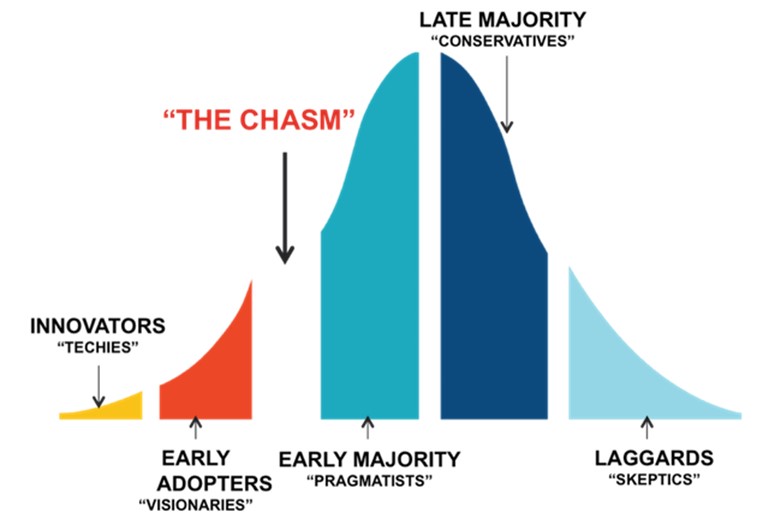
There’s a well-documented trend in the uptake (and eventual decline) of a new technology. The hardest challenge is to get past the “early adopters” (those who simply must have the latest tech) to the people like me, who only buy technology because we feel we really have to. This is sometimes referred to as “crossing the chasm”, taken from an excellent book by Geoffery Moore. What I’m saying here is that for a lot of consumer products, estimating that lifetime is fairly easy.
In our business it can be a little different. In my blogs I have several times referred to noble gas MS technology advancement as the most established / mature / sloth-like (take your pick!) sector of our business. Many of the products currently available have not been significantly changed for over 20 years. Therefore the product life-cycle and eventual product cancellation (referred to as “sunsetting”, how twee) is a less obvious reason to stop making the product. But it can still be the case, so bear with us vendors when it happens.
So whilst lack of profitability and planned obsolescence are two reasons to stop, there are plenty more. A major issue we have encountered here at Isotopx is the supply of critical parts. Certain electrical components, including PC boards, have themselves got finite lifetimes and anyone who works in product development knows you really don’t want to go changing boards half way through a product’s lifetime. In certain cases, the lack of availability of those parts can effectively stop your ability to supply your product whether you like it or not.
Another reason can be an overlap of products within a group of companies. Early on in my career I product managed an MC-ICP-MS at a company called VG Elemental. The company was acquired by a much larger organization (so far so good), but it then transpired they already had an equivalent product within their portfolio (not so good). The parent company took the only option that was realistically open to them; they cancelled one of the products. Not ideal for the product manager (me) let alone the existing and prospective users. But with hindsight, it was the sensible commercial decision.

I’ve covered quite a bit about the reasons why, now let’s take a look about how the decision should be handled. I mean, when is the right time to tell your community that a product is being withdrawn? The simple answer is that there is almost never a good time, due to the conflicting demands within an organization. If you cancel a product too early… you get left with huge piles of unwanted stock (not may people want to buy a discontinued product) that you have to sell cheaply or even scrap. If you leave it until the last minute i.e. when your product stock is running out, you’ve got orders in progress for discontinued products. It’s no fun being the sales person that has to tell their customers that the shiny new things they are getting delivered next month are already obsolete. As a vendor then, you can’t really win this and so you can only do your best to judge the time right, and perhaps slightly sweeten the deal for those customers getting the end-of-line stock.
What you can do as a vendor is at least make a promise to look after those obsolete products. I am told that the legal requirement for support of a cancelled product is seven years. That’s great if you bought a TV, less great if you bought a noble gas MS – we already know they last forever (if you don’t believe me, read my old blog about this here). I believe that all of the vendors in our community will support high end mass spectrometers for a lot longer than the minimum requirement. And for us vendors, if it does look like the stock of parts is dwindling with no opportunity to buy more, we should give our users plenty of warning (to be fair to us vendors, we generally do, it’s often called “last buy” or something similar).
On to the last part; what do you do if you find out the product you have on order for has been cancelled? I think the main thing to do is engage with the vendor early. Find out who is the best person to speak to about support and spare parts, make friends with that person and reach out regularly, ask them to keep you posted about parts availability and changes in the front line of support. They’ll be happy to help, particularly your local sales representative (who will be mindful that their next sale may come from you!). Make a nuisance of yourself if necessary.

The obvious additional step is to stock up on the consumables and spares that you are likely to need, subject to availability to do so of course. Another proactive thing to do is find out about the potential for third party support after the product has slid gracefully beneath the waves. By example, there is a UK-based company that looks after some of the older MC-ICP-MS instruments supplied by one of the major vendors. This relationship works well, with support passed over pretty seamlessly from the original vendor to the third party support agent.
I think the final point about action is to engage with other users. Some of our isotope ratio communities have very active discussion groups and these will be a valuable asset to use to find out where support and parts can come from.
That’s all for now. If you have any comments about this blog, or any experiences of a difficult (or indeed painless) product cancellation, please let me know. As always, send your emails direct to me at: (Stephen.guilfoyle@isotopx.com). More next time!