
Regular readers of this blog know that I am fascinated by analytical instrumentation, a fascination that borders on obsession when it’s related to isotope ratio analysis. Recently I was lucky enough to attend the Winter Conference on Plasma Spectrochemistry. Not the most enticing name, but this is a fantastic conference that is quite instrument / method heavy (ideal for me). It’s also in a rather salubrious location (if you know, you know…).
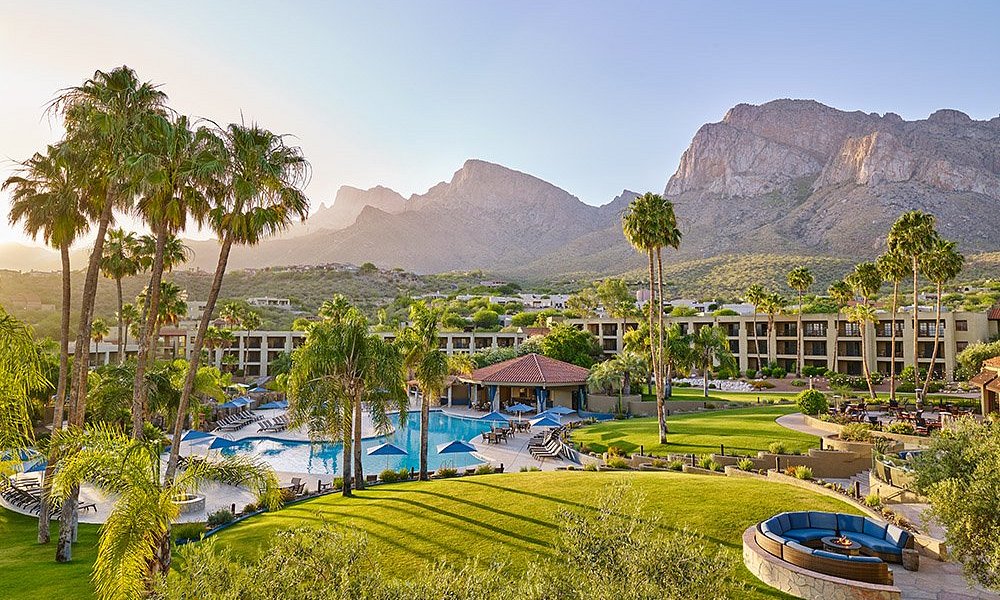
I’ve been to this conference a number of times before, but this time had the added benefit of being invited to see some of the labs at University of Arizona (the conference was held this year in Tucson). I visited the highly regarded Arizona LaserChron Center (an NSF-supported shared facility), link here. It’s one of the few U-Pb geochron facilities I have been to that works 24/7. I doff my cap to the staff that keep the cogs turning and churning out data.
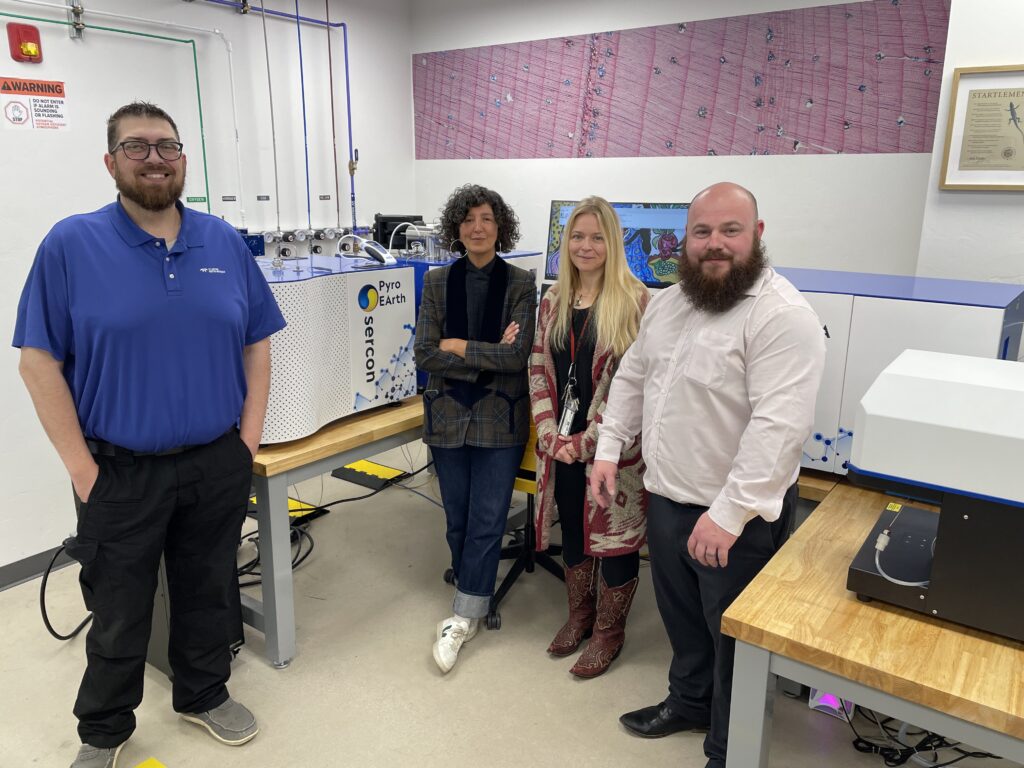
I was also invited to the TIME lab elsewhere on campus, a lab devoted to dendrochronology. This facility is dedicated to the radiocarbon science and isotope studies of tree rings to allow for proxy studies of paleotemperature, amongst other branches of dendrochronology, if you’ll pardon the pun. The instrumentalist in me was able to fully geek on the lab’s accelerator mass spec (pretty much the ace of spades in my scientific instrument pack of cards). But what was more intriguing is that the lab also recently acquired stable isotope MS (IRMS) hooked up to a laser ablation system. I’ve been aware of this technique for a while but had never seen a fully functional set-up, nor seen one used in anger.
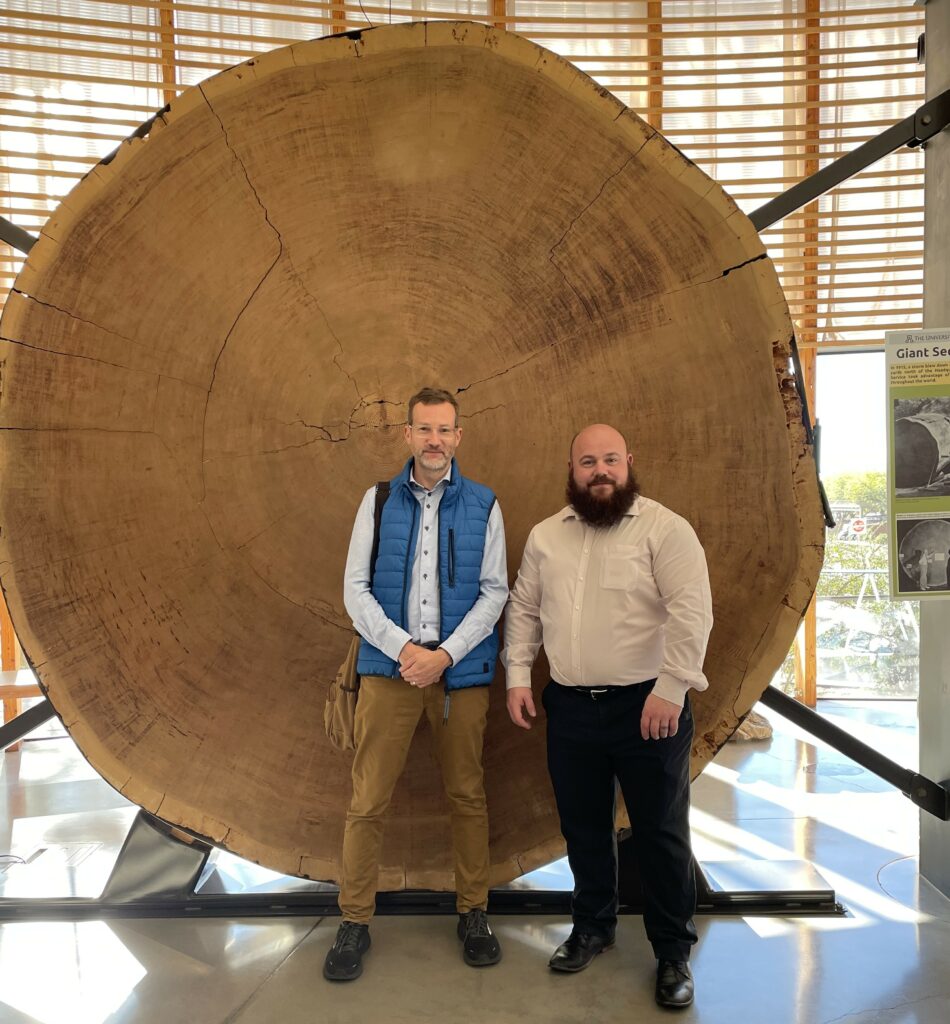
The TIME lab tour was given by Assistant Professor Soumaya Belmecheri, she’s a passionate advocate of the LA-IRMS technique and so was the perfect guide. So, why LA-IRMS? Let’s take a step back. It’s been known for generations that tree rings contain a wealth of information, the thickness and coloration relating to temperature, availability of water and sources of nutrition, as well as environmental factors. In fact there are several journals dedicated to this type of analysis, for example here.
But that’s just the beginning. The use of high resolution AMS is fairly easy to understand – the measurement of the 14C isotope gives an exact and unambiguous age to the tree. This is especially important as apparently the dendrochronological age and radiocarbon age don’t always match up! And the variation in the light stable isotopes (specifically carbon and oxygen) can give yet more fine structure about the life cycle of the tree and the environmental factors that have impacted the growth of the tree. This can be a proxy for understanding the temperature, and the variability of temperature, during the life cycle of the tree.
So far so good, but the reality of using IRMS to measure ring-to-ring differences in isotope ratios is very challenging. As you probably know, for IRMS it is common to use some kind of preparation system to introduce the sample to the mass spec. This is often a simple combustion system such as an elemental analyser. To use this method you need to obtain part of an individual tree ring in question and prep it before it can be combusted. Now imagine you have hundreds or even thousands of tree rings, that may be less than one millimetre wide (much less for certain slow growing trees). This becomes a Herculean task.
Now imagine if you don’t need to do any of that laborious sample preparation to isolate part of an individual growth ring; and the key to that is laser ablation. This is a technique that has been routinely used as a sample introduction system for ICP-MS for several decades. A finely-focused laser beam can target an area down to 100 microns in diameter or smaller, meaning that it is possible to sample material from even the narrowest of growth rings.
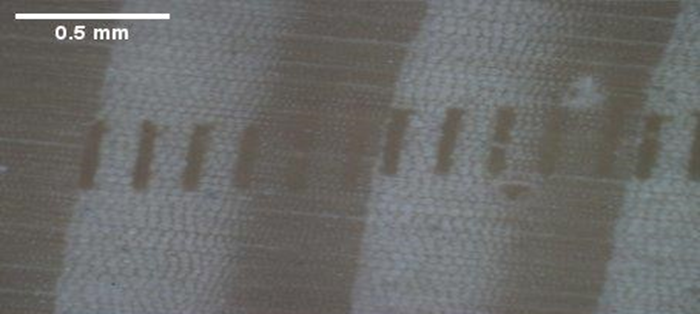
In the case of LA-IRMS, the ablated material from the growth ring is in a vaporized state and therefore can be introduced directly into the IRMS. As you can imagine, this readily facilitates isotope ratio measurements of the light stable isotopes with micron-scale spatial resolution. So, much as LA-ICP-MS is used to “map” the varying lead and uranium isotope ratios in zircon crystals, LA-IRMS can map out the variation in the stable isotopes not just from ring to ring but potentially revealing fine structure isotope ratio variation within a single ring.
This exciting analytical solution does seem to be gaining traction. It does take some careful set-up, and much consideration of the correct sample stage and laser conditions (fluence, spot size etc). The most “complete” solution for LA-IRMS is the combined Sercon – Teledyne Photon Machines – Terra Analytics system, detailed here. This triple-vendor package already has a sizable installation base that continues to grow. It will be interesting to see how this technique evolves, and whether there are any potential analytical offshoots; split stream laser ablation with both IRMS and ICP-MS anyone? Let’s see!
That’s all for now. Hopefully this blog was a good basic overview to this emerging technique. If you have experience of LA-IRMS, or have comments about the content, then please send your emails direct to me at Stephen.guilfoyle@isotopx.com. More soon…