I first heard about “clumped isotopes” from a colleague about 16 years ago (thanks Andy L!). The isotope ratio MS company I worked for was in the process of breaking into the IRMS (isotope ratio measurement of the light stable gases). It seemed that the measurement of these fancy clumped things was an evolving application with great promise for certain isotope ratio applications. But it is fair to say that at the time, it was a fairly “niche” application and much less likely to generate new business than the more traditional IRMS applications (carbonates in geochemistry, forensic science, agronomy, food adulteration… you get the drift). Nevertheless, Andy did the research and found this to be an interesting, if rather challenging application.
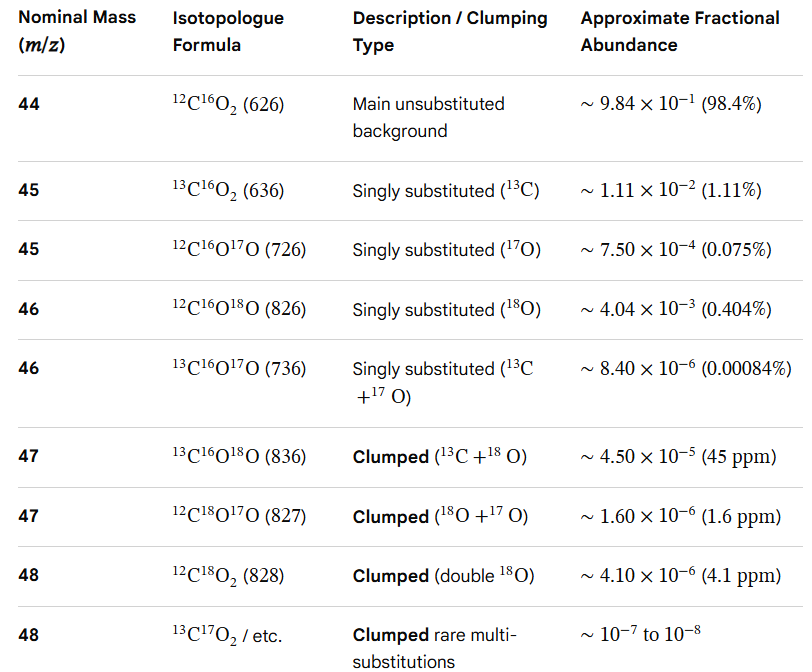
But what are clumped isotopes, and what are they for? You’re familiar with molecules, and you’re familiar with isotopes…. So you already know what a clumped isotope is. Let’s use CO2 as an example, mainly because that’s one of the most commonly-measured clumper (my word, before you complain it is not used scientifically). Your chemistry brain will tell you that the molecular mass of CO2 is 44, consisting of a carbon (m/z 12) and two oxygens (each m/z 16). Sixteen plus sixteen plus twelve makes 44, all good, right?

But then we get to the isotopes bit. Not all oxygens are equal. About one in every 500 oxygen atoms is m/z 18. Therefore if you have a molecule of carbon dioxide, and one of the oxygen atoms is one of the very rare m/z 18, then your molecule is a bit heavier; 16 + 18 + 12, making a total of 46. But there is another form of oxygen too, an even rarer isotope with m/z 17. Less than one in 2,000 atmospheric oxygen atoms are of this kind. You can see where this is going. If your molecule of CO2 has one of these super-duper rare m/z 17 atoms then your CO2 molecule has m/z (16 + 17 + 12) = 45. All clear so far?
Good. Now imagine that your molecule has not one but two of the rare m/z = 18 oxygen atoms. These are ultra-rare, but statistically possible. Here the mass of your CO2 molecule will be 18 + 18 + 12 = 48. In other words, far heavier than the most common form of CO2. Now to make it even more complicated, the carbon atom also has an alternative (stable) isotopic form; m/z = 13.
Side note: I know there is also a version of carbon with m/z 14 but we are ignoring it due to the fact that it is radiogenic (not stable).
So, if your CO2 molecule has a “heavier” carbon atom (m/z 13) plus two “standard” oxygen atoms (each m/z 16) then the molecule has m/z 13 + 16 + 16 = 45. And now you understand clumped isotopes. And by the way, when there are molecules that have differing isotopes leading to different masses, then we refer to them as isotopologues. One of isotope science’s greatest words, don’t you agree?

In a future blog I will discuss why the differentiation of these isotopologues / clumped isotopes is important. For now, just be aware that it is one of the many tools used by scientists to understand long term climate change, and to help predict future climate change. Back to the measurement… obviously we use an isotope ratio mass spectrometer for the differentiation; the type of IRMS we use is important, we’ll get to that in this blog.
But wait!! We’ve now identified two different CO2 molecules that both have m/z 45. One of them has a single heavier carbon atom and the other has a single heavier oxygen atom. Surely we should separate them out with the mass spec as well? Not so fast; the difference in mass between these two different isotopologues (let’s use the correct nomenclature: 13C16O16O {even better; 13C16O2} and 12C17O16O) is so vanishingly small that the mass spectrometer needs to operate at super high resolution (more than 50,000 if you’re interested).
There are mass spectrometers that can operate at this resolution but they’re more commonly used for protein and peptide analysis of much bigger molecules. And they cost a ton more money.
Second side note: these isotopologues that have basically the same mass to charge ratio, like our m/z 45 example above, are called “isotopomers”; these science words just get better!
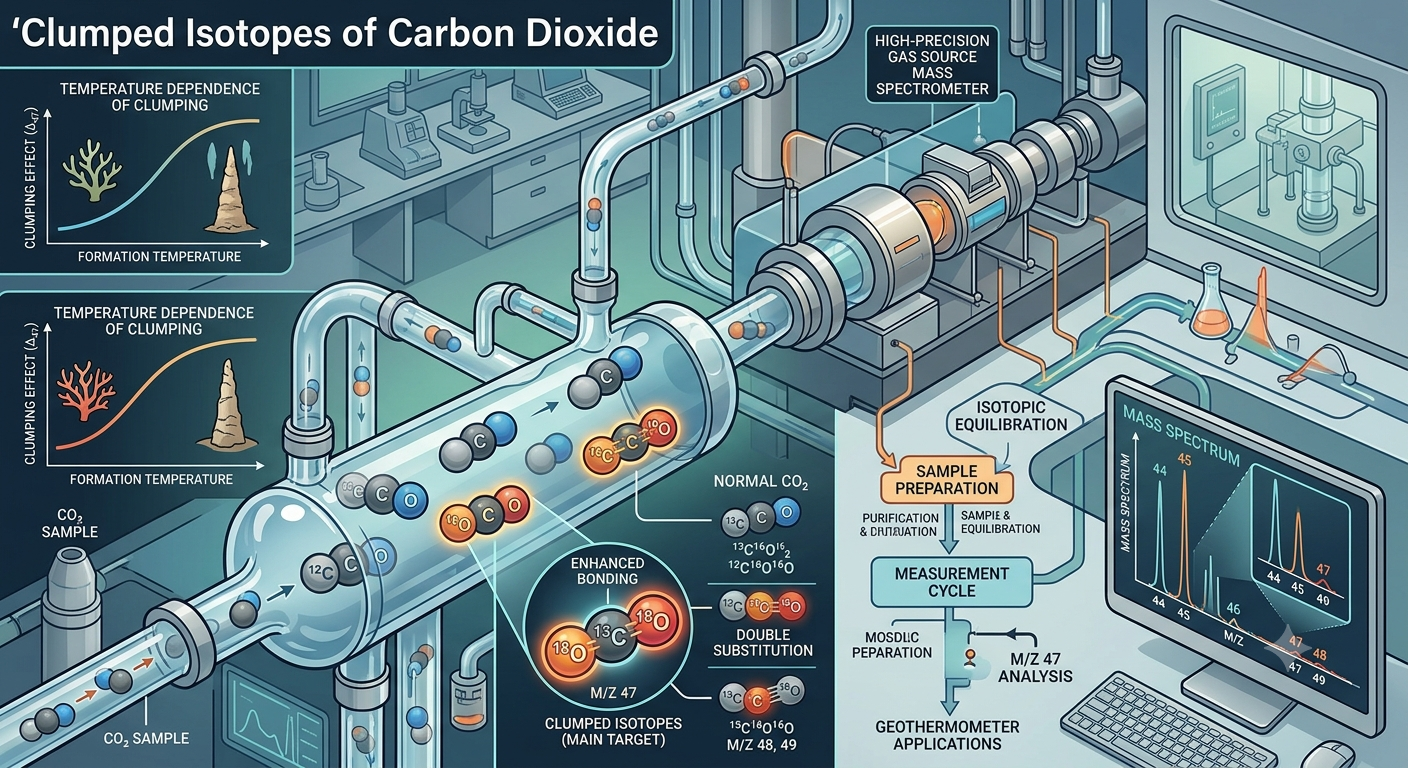
So what type of mass spectrometer IS typically used to measure the clumped isotopes of carbon dioxide? Actually, if we exclude the isotopomers discussed above, then most IRMS instruments on the market can be used to measure at least some of the clumpers. There is no special requirement for high resolution, and the carbon dioxide is usually analysed as a gas, a nice easy job for most IRMS.
Third side note; the sample is more likely to be a solid, typically something like a piece of rock or fossil, meaning some sample preparation is required. Fortunately that can be done readily, and in an automated fashion, using something called a carbonate prep system. But that’s another story.
We all know, however, that not all mass spectrometers are equal. Some are better able to measure the isotope ratios in these clumped isotopes than others. For starters, your MS needs to have a bunch of detectors to allow simultaneous measurement of them. Jumping from one mass peak to the other using a “single collector” instrument simply isn’t precise enough. It’s quite typical to measure the CO2 at m/z 44, 45, 46 and 47. Therefore you’ll need five detectors as a minimum. But because the abundance of the isotopologues varies so much, the lower abundance ones may be swamped by the “tail” from the higher abundance isotopologues. This is abundance sensitivity, and you can read more about it in an earlier blog here.
The problem with the tail is that when there is one, you’re not measuring the actual abundance of the isotopologue accurately. In simple terms, the abundance is the difference between the height of the peak and the baseline; so one way to help the accuracy is to ensure a good baseline measurement. Therefore many researchers in this field like to take one baseline measurement at half a mass unit less than the measured peak, and another at half a mass unit more than the measured peak. You can use an algorithm to calculate the actual baseline at the exact position of the analyte peak with these two measurements.
I’ve heard these referred to as “half mass baselines”; and as you can imagine, if you want to make this measurement you need a bunch more detectors to measure these half mass baselines at the same time as the analyte peaks. Ideally then, the more detectors the better, and if they can be easily moved to locate some at those half mass positions, all the better.
Then we get to the really rare isotopologues, at m/z 48 and 49. These are ultra-low abundance (think parts per million or even billion). In the case of these isotopologues, the ion beam signal is so low that it may be hard to get a good measurement, due to the inherent limitations of the detector (usually of the Faraday kind). Once option is to use a mixture of Faraday detectors (for the higher abundance clumpers) and ion counting detectors for the really rare low abundance kind. Mixing detector like this does have its place, and is commonly used in some branches of isotope mass spectrometry such as U-Pb geochronology.
However, it does make the analysis more challenging due to the regular cross-calibration between the detector types. Here is where the ATONA technology from Isotopx can help. This type of Faraday has a huge dynamic range, meaning you can put all of those isotopologues, from the biggest to the smallest, onto one detector type. Does it help the analysis? Definitely! We already have some data here, and we’ll be producing more soon. Until then… that’s all I’ll say about clumped isotopes. As you can probably tell, I am far from being knowledgeable about this subject so I am happy to be corrected where I have made mistakes. In a future blog I’ll take a look at how the degree of clumping helps science.

To that end, if you have any clumping comments to make, please let me know at the usual place, I’d be keen to hear: (Stephen.guilfoyle@isotopx.com). More next time!