
The other day I met an actual writer at a bar. And a writer of science fiction and fantasy, no less. As we talked about the possibilities of time travel and quantum entangled goblins (that bit didn’t happen, I’m paraphrasing) it did get me thinking about the paradox that is the difference between creative writing and scientific writing.

I do a lot of scientific writing – after all it’s a key part of my job. I spent a fair proportion of my working life writing and editing content to describe the products and solutions that we offer at Isotopx. I strive for clarity like all scientific writers do. Unnecessarily overly descriptive content is stripped out to give the reader the bare bones. This has been the scientific method for many decades; you’d probably have to go back a hundred years to find content published in scientific journals that uses rather too many adjectives.
But yet I also read a lot of science fiction and fantasy. This is a genre that can be surprisingly up to date. My own experience being that one of the fastest growing categories in this group is climate fiction (Cli-Fi really is a category). I’m reading a lot of this type of fiction at the moment, a personal recent favorite being “Juice” by Tim Winton. Obviously, this is fiction, so the use of adjectives is encouraged not just allowed. I can lose myself in a well written book in a way that I never could with an article in The Journal of Mass Spectrometry (other journals are available).
Therefore my point is; can there be a place for creative prose in hard-nosed scientific content? The short answer is obviously “Stephen, don’t be stupid”. But in a world where we genuinely worry that AI is going to take over (another growing science fiction category), maybe there is an opportunity to present dry scientific content more creatively. I turned to ChatGPT and asked whether some of my scientific content could be repurposed in the style of a particular writer. “Yes” it said, in a scarily calm voice reminiscent of Hal in the film 2001: A Space Odyssey.

I started with Bram Stoker, famous for.. well, I think you probably know. I took some content from the NGX brochure that I recently rewrote, and this is what Mr GPT created for me:
A strange and most modern contrivance has emerged from the industrious hands of Isotopx—the NGX mass spectrometer, the latest incarnation of its kind. Within its intricate frame resides an assembly of advanced multicollector apparatus, wrought together with a design both austere in volume and formidable in its sensitivity and resolution.
It is a device of uncommon power and adaptability, possessed of a keen discernment for the faintest whispers of noble gases, as though it listens to secrets long buried in the very fabric of the earth. Yet, despite its complexity, it yields itself readily to the guiding hand, its operation curiously intuitive.
So, what do you think? Will this help Isotopx to sell more NGX noble gas mass spectrometers? Surely not, but as an experiment it is at least a lot of fun! I thought I’d try another writing style, and figured Jack Kerouac might be a good choice; obviously a totally different kind of writing to Bram Stoker. This is what Chat (we’re on first name terms now) came up with:

Man, the NGX mass spectrometer from Isotopx just rolls in like the newest ride on a long electric highway, the latest beat in the lineage of these machines, humming low and alive. It’s got this wild multicollector setup—real sharp, real tuned—paired with a lean, stripped-down body, all high sensitivity and fine resolution, like it’s listening to the tiniest vibrations in the universe.
Pretty good huh? But both of those writers were contemporary enough to not pose a huge challenge when converting current writing. I figured a bigger challenge would be to use a writer from so long ago we can almost use geological terms, someone like Chaucer. This is what Chatty (maybe we are getting a bit over-familiar??) came up with:
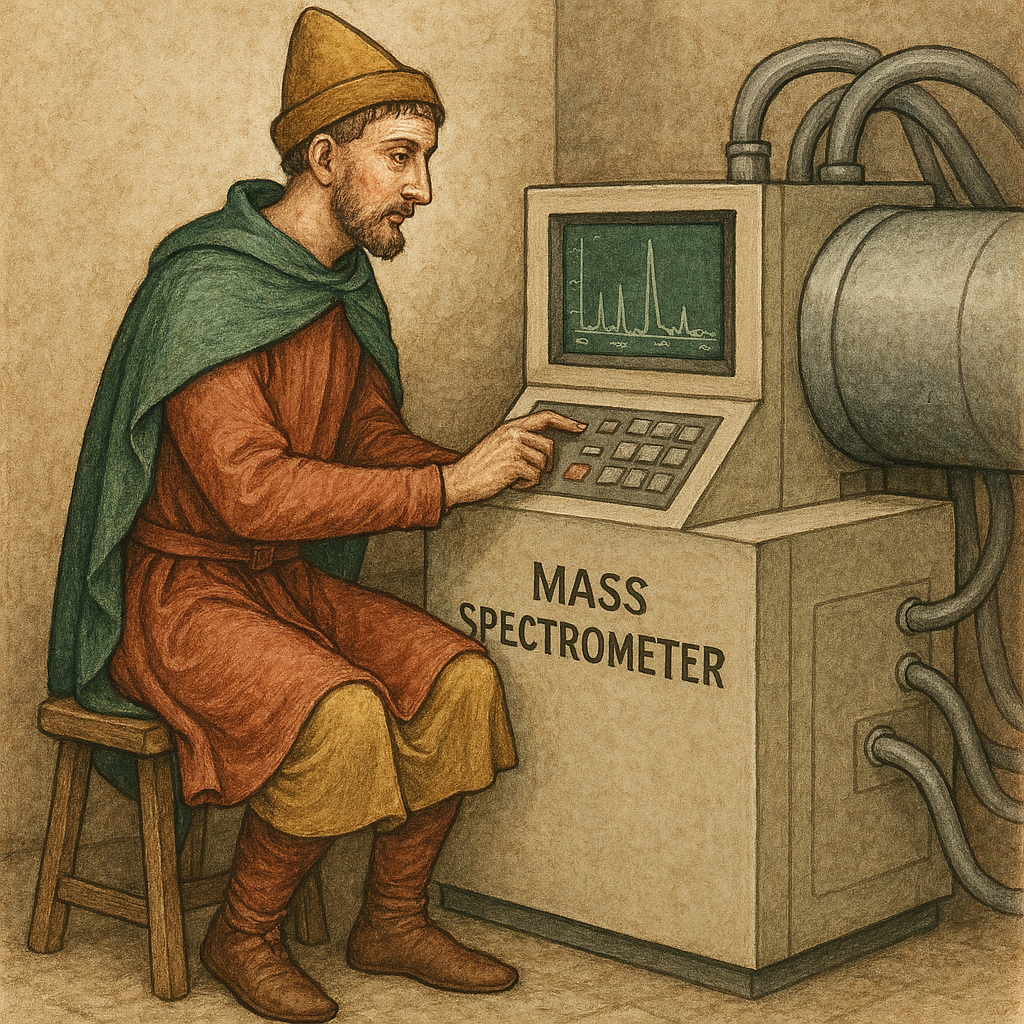
Lo, from Isotopx cometh forth the NGX,
The newest craft of al this instrument kinde;
A wonder wrought with subtle arte and flex,
Where many a collector is y-joined and binde
With werk ful smal in volume, yet refined,
Of heigh sensibilité and resolucioun clere,
To weyen gases that be most hard to finde
Does it still work? I think it does! I will be very honest that I am not an avid reader of Chaucer, and having been briefly introduced to his scribblings at school I did find them a bit of a challenge. The ChatGPT- created content is in my opinion pretty representative of what I remember; beautiful when you dig deep, but superficially quite opaque.
So what have we learned? Clearly there is no sensible use for highly stylized content when the original is perfectly clear. But for purely fun purposes, dry scientific content can be made more entertaining even if it does rather lose something in legibility. So as the Earth gently warms to the emissions created by my overuse of power-hungry AI data centres, I will close this blog.
Let it be understood that these words proceed from my own solitary judgment, and not from the sanctioned voice of Isotopx, whose designs and intentions lie beyond my authority to declare. Should you encounter, in the shifting currents of the public sphere, any mention of isotopes—be it laudatory or ill-omened—I entreat you to dispatch your observations directly to me, by that curious electric post which binds distant minds (Stephen.guilfoyle@isotopx.com).